
Two Young Napoleons
A young, handsome technocrat with a record of political flexibility meets, well, Emmanuel Macron

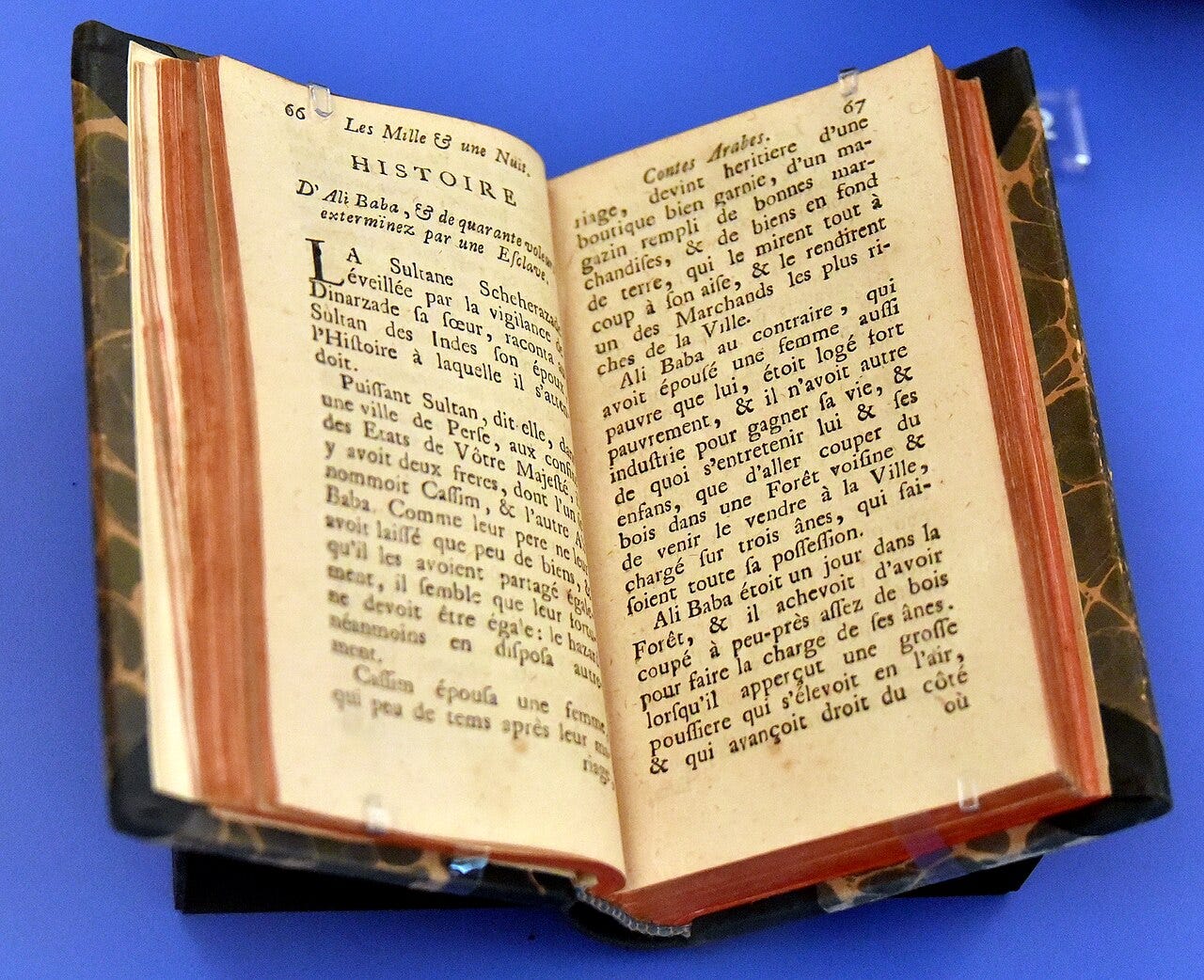
In 1709, the French Arabist Antoine Galland, author of the first European version of the Thousand and One Nights, noted in his diary a conversation with a Syrian Maronite acquaintance of his, whose name is recorded only as Hanna.
According to Hanna, someone had recently noticed something untoward about a piece of satin then being used to cover the canopy that held the Blessed Sacrament when it was carried in procession at Nôtre Dame: upon it was emblazoned the shahadah, the Muslim profession of faith.
The cloth had presumably been seized from some Berber or Turkish ship, and since no-one had been able to read the script, a text declaring the oneness of God and Muhammad’s identity as his prophet had been sitting in the most important cathedral in France for some forty years. The cloth was duly taken down and burnt.
Little did France know that it was in the early stages of what would prove to be a long fascination with the Levant. At the end of the same century, another Arabist, François-Constantin de Chassebœuf, better known as Volney, travelled in Egypt and Syria, and wrote a (profoundly prejudiced) anthropology of these Ottoman provinces, kickstarting Orientalism in the process.
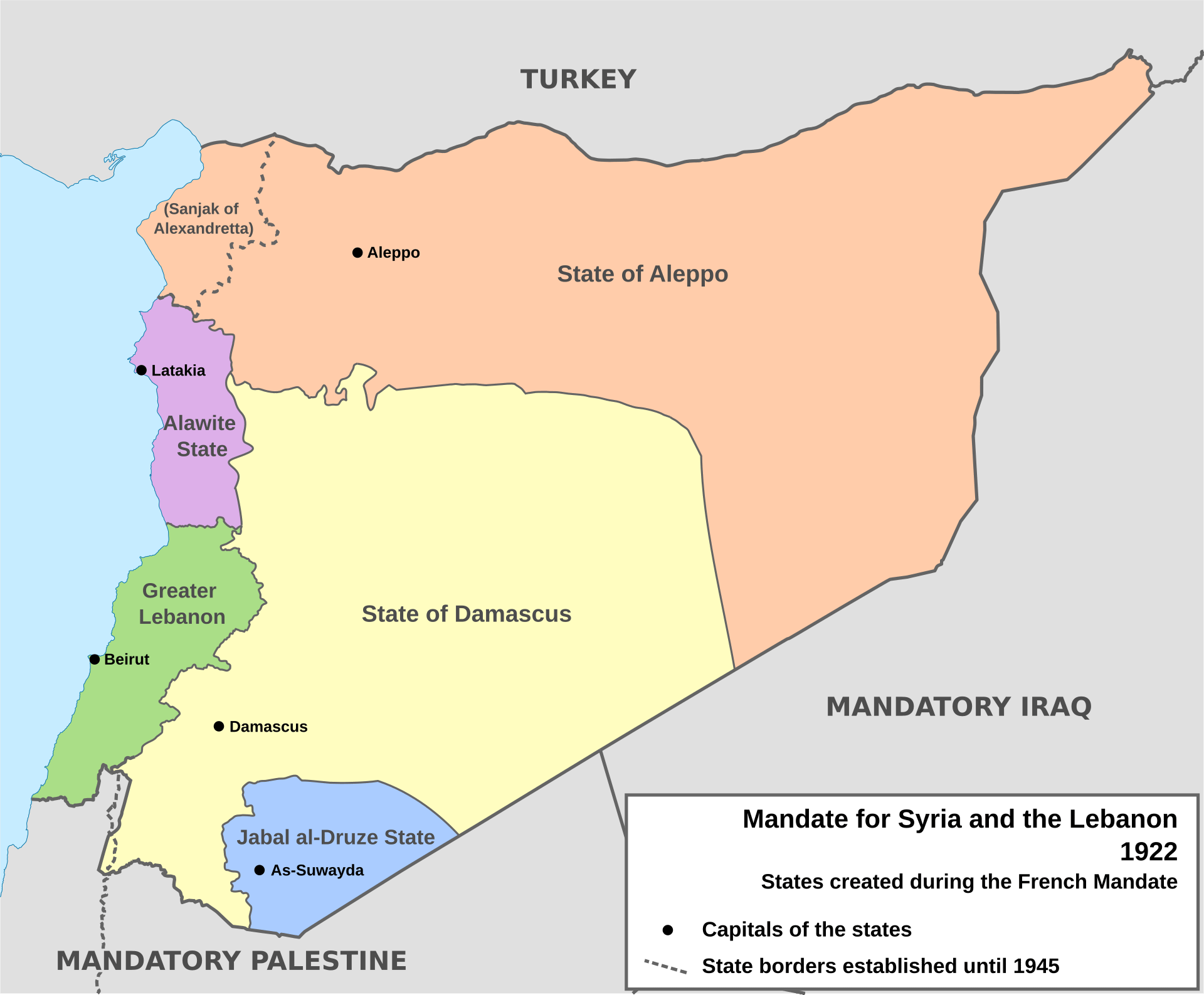
After the First World War, it was France that took on the League of Nations mandate for the northern part of the Ottoman province of Syria, from which had been shorn its southern region of Palestine, duly handed to the British instead.
The French imposed their rule with an iron fist, crushing a nascent independence movement in 1925. They also redrew Syria’s borders further by carving off Lebanon as a majority Christian state, believing this would help to maintain French control. To this day, much of Lebanon speaks French, although the language is fast losing ground to English.
Emmanuel Macron partakes in his countrymen’s long and often bloody enchantment with the Arab world. Back in 2019, when Lebanon erupted in protest following the port blast that devastated Beirut, he was the first western leader to visit the country, making empty promises to help change Lebanese politics and rebuild the country.
When he returned to the Élysée Palace, having achieved precisely nothing of any value, he was saluted by an orderly with the habitual “bonjour”. Jovially the president replied “bonjourayn” – imitating the Arabic (when you say “hello”, “marhaba”, the response is “marhabtayn” – “two hellos”).
But Macron’s involvement in the politics of the Levant is not all personal. While the area may long since have ceased to be a French colony, France has worked hard to maintain its interests in the area, whoever is in charge.
Under Jacques Chirac, that meant cultivating warm ties with Hafez al-Assad, who carved a bloody swathe through his own people. Just over a decade before Chirac came to power, he razed two-thirds of the city of Hama to the ground, massacring up to 40,000 people in the process.
Nicholas Sarkozy, for his part, tried to reintegrate Bashar al-Assad, the son and successor of Hafez, now wanted war criminal and guest of Vladimir Putin, into the international community.
France’s love affair with Syria’s butchers ended only with Assad junior’s brutal repression of the 2011 revolution, and then his unrestrained savagery in the civil war that ensued.
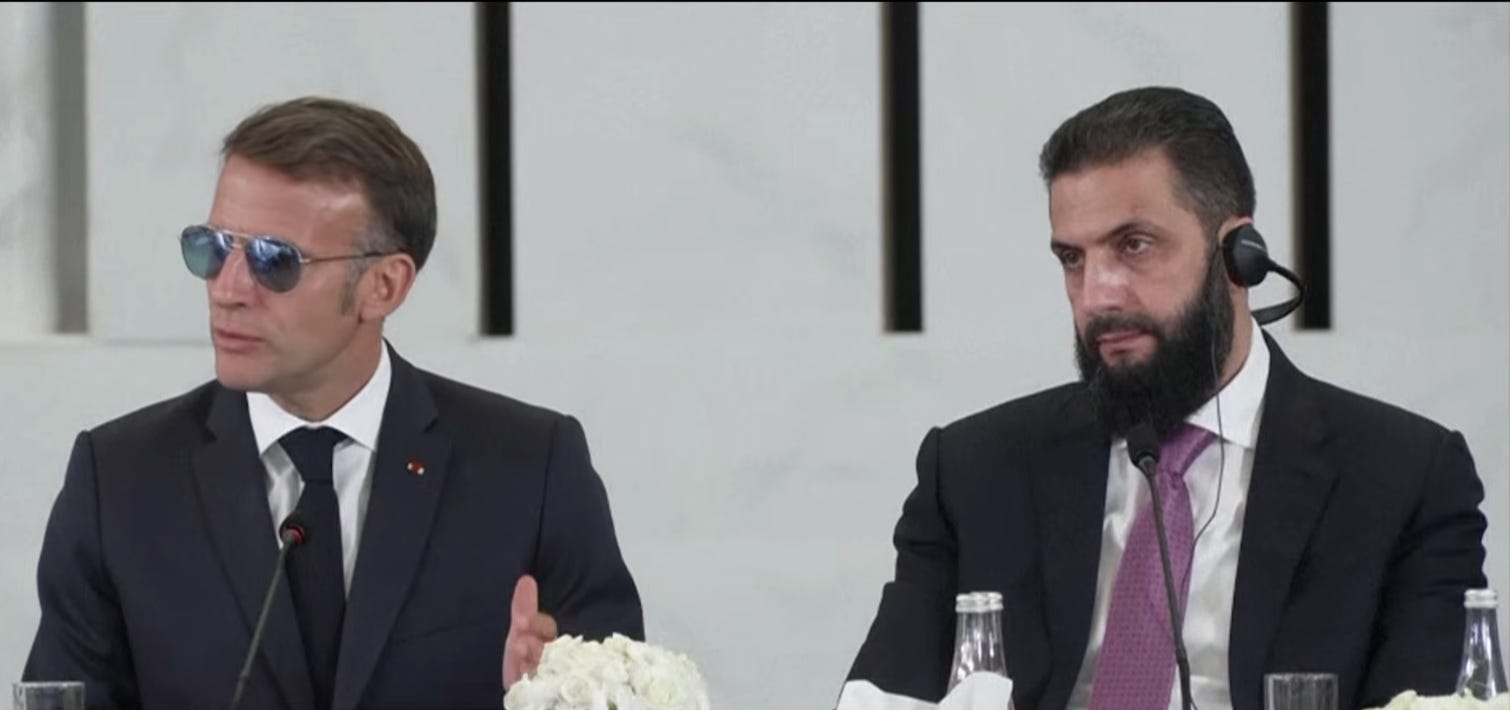
Assad was finally overthrown by the Islamist movement led by Ahmed al-Sharaa in 2024. Al-Sharaa has already shown himself to be a deft diplomat who has been highly successful at bringing his country in from the cold.
Macron’s appearance in Syria is the latest proof of that. But then, the French president is also more than willing to be wooed. Last year, he became the first Western leader to welcome Sharaa for an official visit, and he also called for sanctions on Syria to be lifted.
Macron is no doubt flattering himself that the two men are, in some odd ways, alike. Al-Sharaa is a pragmatic technocratic who came to power at the head of a Sunni Islamist movement but quickly tacked in a more secular and ecumenical direction.
The French president likewise joined an existing movement, rode it into power, and then governed as suits him – although the Parti socialiste under François Hollande was admittedly less heavily armed than al-Sharaa’s Hay’at Tahrir al-Sham.
What does each man want out of the relationship? Above all, what al-Sharaa needs to ensure the survival of his nascent state is investment to restart the economy and raise living standards – hence the cloud of business leaders that accompanied Macron on his visit.
This too is a standard model, from China to Iran, where the newly-reconstituted technocratic regime is looking to relegitimise itself through growth and prosperity (although Sharaa would justly resent the comparison with the nation that gleefully participated in the slaughter of his people).
But what is in it for Macron? As is the case with prior French presidents, Macron is little interested in al-Sharaa’s rights record: the massacre of Alawis last year and continuing wrangling with the Kurds will not be enough to put him off, even if he makes a show of calling for the new president to respect the country’s minorities.
Nor will the fact that the new Syria that al-Sharaa is building looks to be less than democratic. One-third of the deputies in the new parliament are appointed by the president – i.e. al-Sharaa himself for the foreseeable future.
In fact, Macron and most other western leaders have a positive preference for a kind of conservative autocracy in Syria. Similar regimes have proved productive partners in the Gulf, Jordan, and Egypt – at the expense of their citizens and often the wider region.
A democratic Syria might, after all, seek to draw international attention to Israel’s brutal occupation of its land in the south, near Damascus, where the IDF has been merrily killing and disappearing people, destroying property, and stealing water – all standard practice when Israel occupies your land, and not something the West greatly wants the world to be talking about.
So it suits Macron to ensure Sharaa’s settlement endures. Macron also has a different set of priorities from other western leaders, however.
The last decade has seen French influence in its former colonies wither at an extraordinary rate. Françafrique collapsed as West African governments expelled French forces and turned to the Wagner Group to fight Islamist terrorists on their behalf instead.
Relations with Algeria, never warm, have reached new lows. Last year, the North African state demanded reparations from France in recompense for its colonisation.
Now it is also losing its grasp on Lebanon as the US muscles its way in. Israel (again) invaded the country earlier this year and (again) occupied much of the south, annihilating whole villages and ethnically cleansing the population.
Israel’s demand is that Hezbollah, the armed group allied with Iran, be disarmed – otherwise, it says, it will not leave.
As the Israeli government well knows, the Lebanese state is in no position to disarm Hezbollah. The official Lebanese army has been kept deliberately weak by the US so that it can never pose the slightest threat to a certain psychopathic state on its southern border.
Moreover, while Hezbollah’s stock across most of the Lebanese population has fallen over the last two decades – not least because of its role in massacring mostly Sunni revolutionaries in Syria, something the large Sunni population in Lebanon cannot easily forgive – it retains the loyalty of its marginalised Shia base.
So even if the Lebanese state were capable of taking on Hezbollah, it would risk setting off a new civil war between the country’s ethnic groups.
At the same time, to have Israel constantly bombing Beirut and committing war crimes in the south is intolerable for a sovereign state. It needs to find some way of ending the fighting.
In this context, only the US is a valuable partner, because only the US has any real sway over Israel. So the superpower has been the focus of all Lebanon’s efforts.
Macron has done his best to maintain some French role in the negotiations in Lebanon, but since he has repeatedly demonstrated that he cannot or will not exercise either French or EU leverage over Israel, he has mostly been left on read.
Enter Syria. Al-Sharaa has succeeded in establishing a warm relationship with Donald Trump, who seems to be charmed by his good looks and, for whatever reason, recently got it into his head that he would like the former Islamist to be the one fighting Hezbollah instead of Benjamin Netanyahu.
Just last week, al-Sharaa attended the Nato conference in Ankara and managed to have his country taken off the list of state sponsors of terror by the US State Department.
But Trump is the world’s least reliable partner, and his brain is melting (he fairly obviously cannot remember al-Sharaa’s name). Bogged down in various other Middle Eastern commitments, he is unlikely to put any concerted effort into helping Syria rebuild – at most, he can be chivvied into removing the remaining US obstacles thereto.
And that is why Macron has made a beeline for Damascus, hoping to establish a French role in Syrian reconstruction before the US can get there – good for the profits of French companies and good for the country’s influence in the region, now that Lebanon has definitively slipped out of its orbit.
The challenge here is that, much like Lebanon, Syria knows the US is far more important to its future than is France.
Assadist Syria was placed under almost every US sanction imaginable, and since the dictator’s fall, these sanctions have been unpicked only in a piecemeal fashion by a Trump administration whose bandwidth has mostly been occupied with the task of pointlessly humiliating itself on the world stage.
These are by far the biggest hurdle in rebuilding Syria, because companies that fall foul of US sanctions face massive repercussions across the global financial system. Until the US has completely regularised the situation, many will be leery of investing in the Syrian economy.
France cannot fix this for Syria, because its own companies are equally afraid of the ripple effects of US sanctions.
Equally, Syria, like Lebanon, needs to deal with the belligerent rogue state that is occupying its southern territory, and knows France cannot solve that problem for them either. Only the US could force an Israeli withdrawal.
That does not mean French friendship means nothing to Sharaa and Syria. Macron’s criticisms of the Israeli occupation and his calls for the lifting of sanctions are both welcome.
However, the limits on what Macron can achieve in Syria are a sobering reminder that international influence is increasingly monopolised by the big three superpowers, and states like France are finding themselves squeezed out rapidly.