
Past & Present
A ceremony to honour France's most famous historian raises uncomfortable questions about its current trajectory

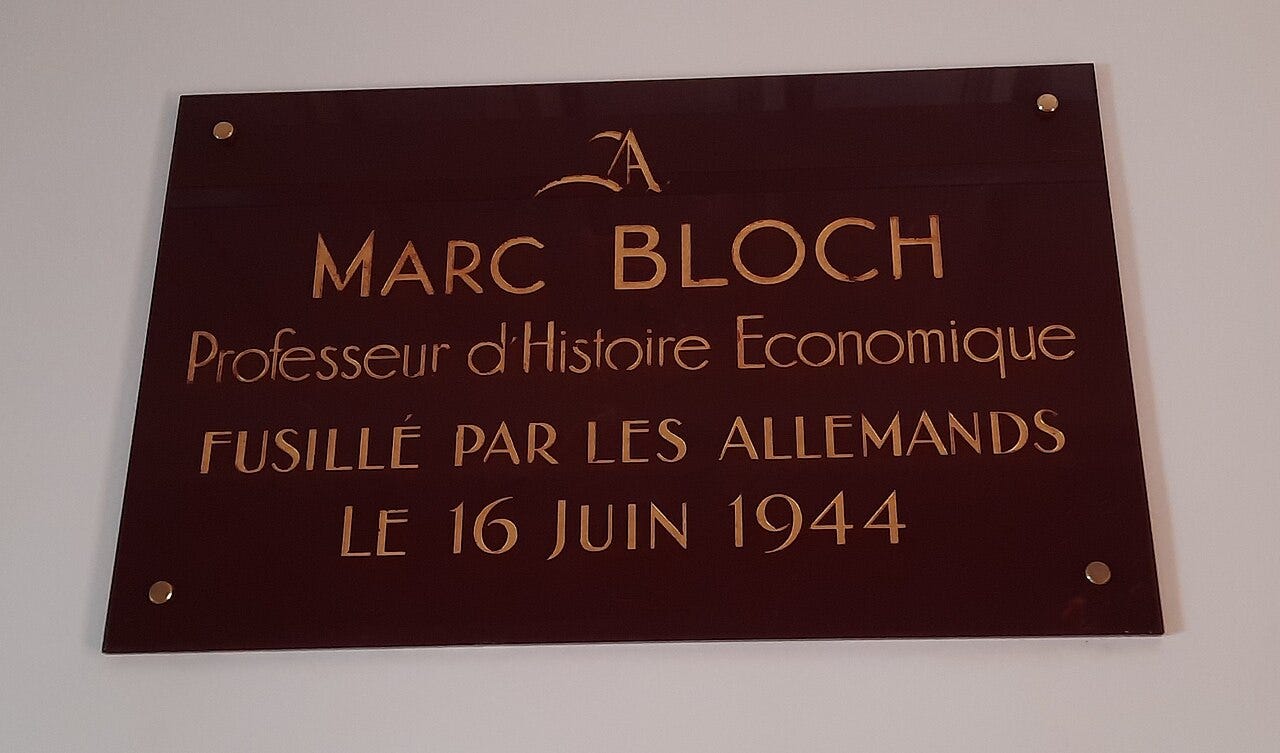
On the morning of 16 June 1944, thirty people were led into a field some way north of Lyon by members of the Gestapo.
They all knew why they had been removed from prison overnight and taken to this remote place. One of their number, only around 16 years old, sobbed: “It’s going to hurt.”
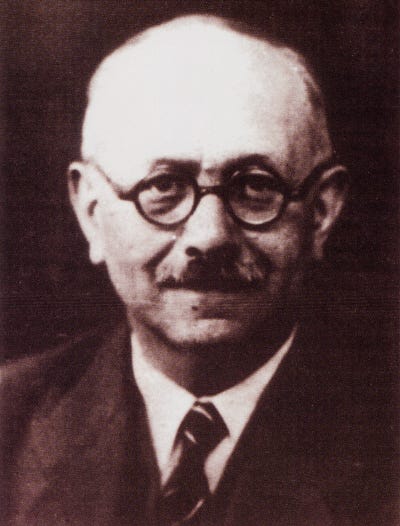
A kindly-looking older man with thick round glasses and the look of a university professor took his arm to comfort him, telling him, simply, “No, little one, it doesn’t hurt at all.”
Then he shouted “Vive la France!” as the Gestapo opened fire behind them.
The man who had gone to his death which such bravery and kindness was Marc Bloch, at the time one of the world’s most famous historians, and key figure in the French Resistance in Lyon.
On 23 June, Bloch will receive the highest honour the French state can bestow: he will be panthéonisé, transferred to the Pantheon in the 5th arrondissement of Paris.
The Panthéon has its own fascinating history. It was originally conceived as a church that was to be dedicated to Saint Geneviève, the patron saint of Paris, who is supposed to have saved the city from being ransacked by Attila the Hun. The main chamber of the Panthéon still sports murals depicting her feats.
However, as the monumental structure was still unfinished by the time the French Revolution broke out in 1789, it was decided that it would instead be the final resting place of the heroes of the emerging French Republic.
The first of these to be laid to rest there was the comte de Mirabeau, the great orator of the early Revolution – only for him to be removed just months later when it was discovered that he had been colluding with Louis XVI the whole time.
Voltaire and Jean-Jacques Rousseau are also commemorated with grand tombs, as well as a plethora of revolutionary and later figures.
In recent years, there have been efforts to commemorate a wider tranche of great historical figures in the Panthéon. In 1998, a plaque was put up to Toussaint Louverture, who led a revolt among the enslaved people of Haiti (then known as Saint-Domingue) in the early 1790s.
And in 2021, Joséphine Baker, the American-born dancer, key figure in the Resistance during World War II, and civil rights activist, became the first Black woman (and only the sixth woman) to be panthéonisée.
Bloch’s own entry into the temple of the Republic is arguably long overdue.
He served with distinction in the First World War, even winning the Légion d’honneur, the most prestigious medal awarded by the French state.
Upon his return to civilian life he became an academic historian and rose rapidly through the ranks of the French university.
He also set about revolutionising historical methodologies in ways that are still profoundly influential today. One of his major contributions was a new comparative method which had borrowed from the study of linguistics.
In 1929 he founded, with his friend Lucien Fèvre, what is still one of the most famous French historical journals, the Annales d’histoire économique et sociale (today published under the trendier title Annales. Histoire, Sciences sociales).
The journal pioneered a new and grand approach to history. It insisted on interpreting historical events and phenomena holistically, i.e. within the largest possible context.
This required them to bring to bear great sweeps of time (known still in English, thanks to their influence, as the longue durée) and huge swathes of the globe to understand what was happening in any given place.
But no-one was better suited to this kind of work than Bloch, who apparently spoke around 10 languages.
The movement that Bloch and Fèvre founded continued after their deaths, and is still known as the Annales school, after their journal.
Bloch reached the pinnacle of his academic career in 1936 when he became Chair of Economic History at the Sorbonne, the most prestigious university in France. And in happier circumstances, he probably would have lived out the rest of his life in this position.
Instead, when World War II broke out three years later, the 53-year-old Bloch, already plagued with arthritis, immediately volunteered for the army once again.
Remarkably, he was sent to the front, where he participated in the Battle of Dunkirk and was among those evacuated to Britain on the Royal Daffodil.
On the basis of this experience, he wrote L’Étrange défaite (the strange defeat), a savage account of the various failings of France’s political and military leadership, as well as wider civil society, that had led to the disaster of 1940.
He immediately returned to France, but later in the same year he was barred from holding any academic position under a new law, passed by the collaborationist Pétain government, that excluded Jewish people from the civil service (teachers at French universities are considered civil servants).
In 1941, one of his former students, now working for the régime, was able to get him an exemption from this law on grounds of his patriotic service, and later secured him a pass to flee to the United States. However, Bloch refused, not wanting to leave behind his elderly mother.
Instead, he struggled to carve out a life in Montpellier, in the face of hostility from the university and the state, before he was finally forced into retirement in 1943, and his work with the Resistance began.
Now 57 years old, he moved, without his family (including his wife, Simonne Vidal, who was suffering from stomach cancer) to Lyon, and began carrying out clandestine missions for Franc-Tireur, a left-wing Resistance movement spread across the south. He soon became one of its chief organisers in the city.
Then in March the following year, he was arrested, dragged off to the prison of Montluc, and tortured for several days. He refused to give his captors any new information. In the evenings, he taught history to fellow prisoners.
Three months later, he died his hero’s death – mort pour la France, the designation given to resistance members who were killed fighting the occupation. Simonne passed away on 2 July without ever having received confirmation of her husband’s demise. It was only officially announced in November, after his daughter identified his personal effects.
War hero, giant of academia, grand résistant – any one of these would have merited Bloch a place in the Panthéon.
But what makes his reinterment in this most symbolic of Republican buildings especially significant is the way in which his life intersected with some of the deepest faultlines now pulling the French Republic apart.
Back in February, Lyon, the city in which Bloch devoted himself to the Resistance, witnessed a violent clash between far-right and anti-fascist activists which resulted in the death of a young member of the former group, Quentin Deranque.
The right lionised Deranque, even securing a minute of silence for him in the National Assembly. Subsequently, it emerged that he was not the Catholic pacifist that he had been made out to be, but a rabid neo-Nazi.
Eighty years on, in the same city in which Bloch devoted himself to the struggle against fascism, the same battles are being fought all over again.
Then there is the issue of antisemitism, which has spiked in France in recent years. According to the Dilcrah (délégation interministérielle à la lutte contre le racisme, l’antisémitisme et la haine anti-LGBT), which is tasked with collecting information on various forms of discrimination, antisemitic incidents have almost tripled since 2022.
As in most countries, this rise in antisemitism has accompanied the Israel-Palestine war and the genocide in Gaza. Some of the antisemitic incidents recorded have been carried out by individuals claiming to be acting in solidarity with Palestine.
At the same time, many on the left accuse the political establishment, with justice, of using antisemitism to discredit pro-Palestine activism and broader left-wing political movements, even when there is no link at all.
For the centre and right, it has been convenient to weaponise antisemitism against the hard left. For the centre, it flows into a broader argument that the Republic is threatened by a far right and a far left that, in their account, resemble each other both in their anti-republican attitudes and in their racism.
For the far right, it helps to distract from their own racism, including the long history of antisemitism specifically in the ranks of the RN.
Yet it is also true that Jean-Luc Mélenchon has not exactly gone out of his way to reassure the Jewish community of his commitment to fighting antisemitism. Instead, he has chosen variously to dismiss the issue, claiming for example that antisemitism in France is merely “residual”, and to engage in his own provocations – as when he joked about the pronunciation of the name “Epstein” at a rally in February.
Both real antisemitism and the more cynical politicking over the issue are likely to play a significant role in next year’s elections, in which the RN is all but certain to make it to the second round, leaving the centre right and Mélenchon to fight for second place.
In sum, bestowing the state’s highest honour on one of the most prominent Jewish public figures in modern French history, on a man who died fighting the Nazi occupation, is a powerful rebuke to rising antisemitism and fascism.
But it is a tragedy that it should take place against the backdrop of a fragmenting social fabric that threatens the foundations of the nation for which Bloch fought.