
Bringing in the repairman
Why is Emmanuel Macron talking about reparations?

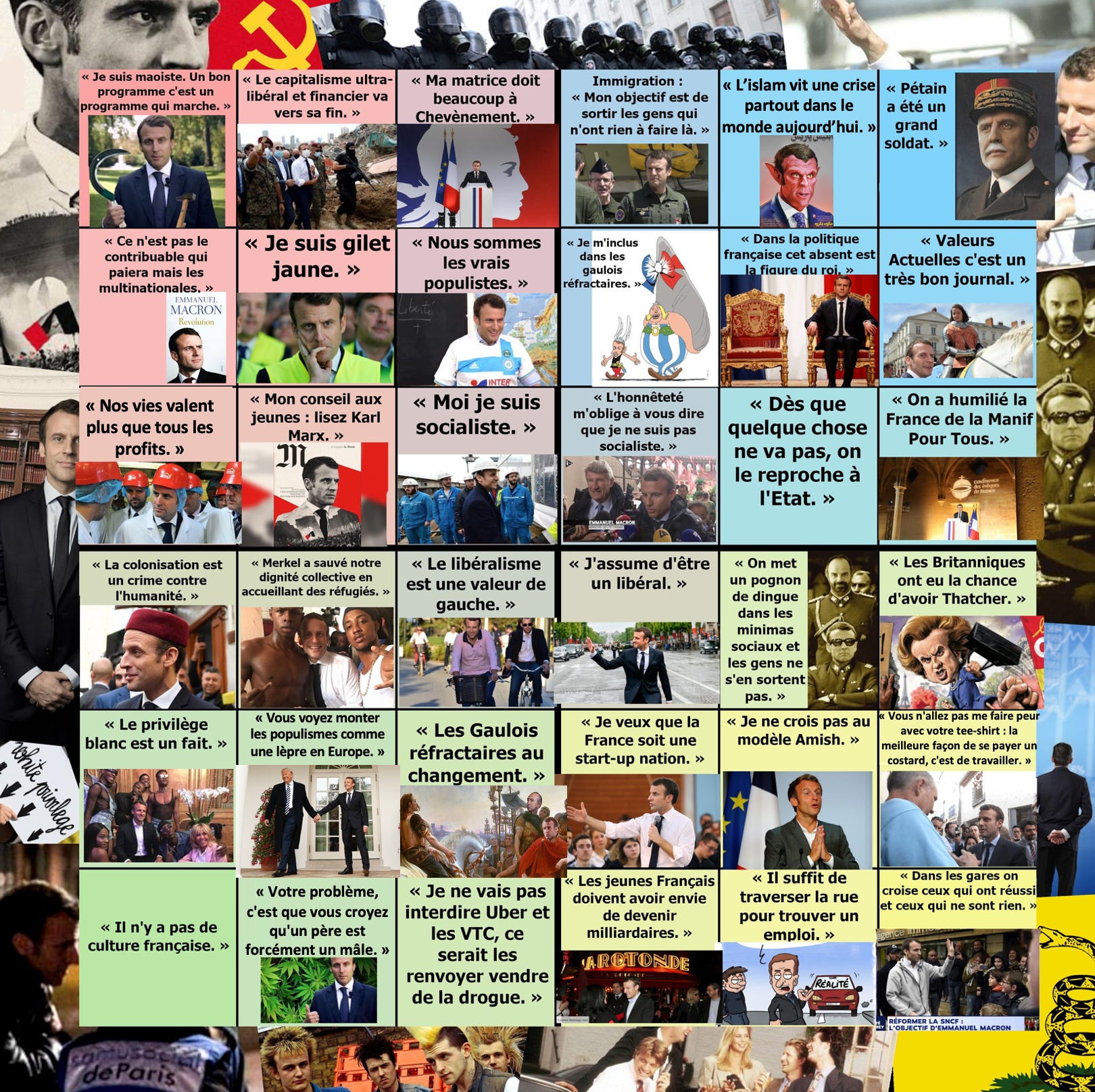
Over the years, there have been various versions of the meme above. It is easy to forget, now that he has shifted so far to the right, that Emmanuel Macron began his career in the Parti socialiste.
Partly as a result, and partly because of his own predilection for playing pointless mind games with the electorate, in his – actually relatively short – political career he has made comments that span the entire political compass.
Among the greatest hits above: “My advice to young people: read Karl Marx”; “In French politics, what is absent is the figure of the king”; “The British were lucky to have Thatcher”; and “White privilege is a fact”.
And sometimes he still lets this last personality, the rare and much cherished Woke Macron, shine through.
One such instance came last week, when he publicly backed the symbolic repeal of the Code noir – about which I wrote a couple of weeks ago, and which was finally passed by the National Assembly yesterday – and went further, accepting the need for some kind of reparations for France’s historic involvement in slavery.
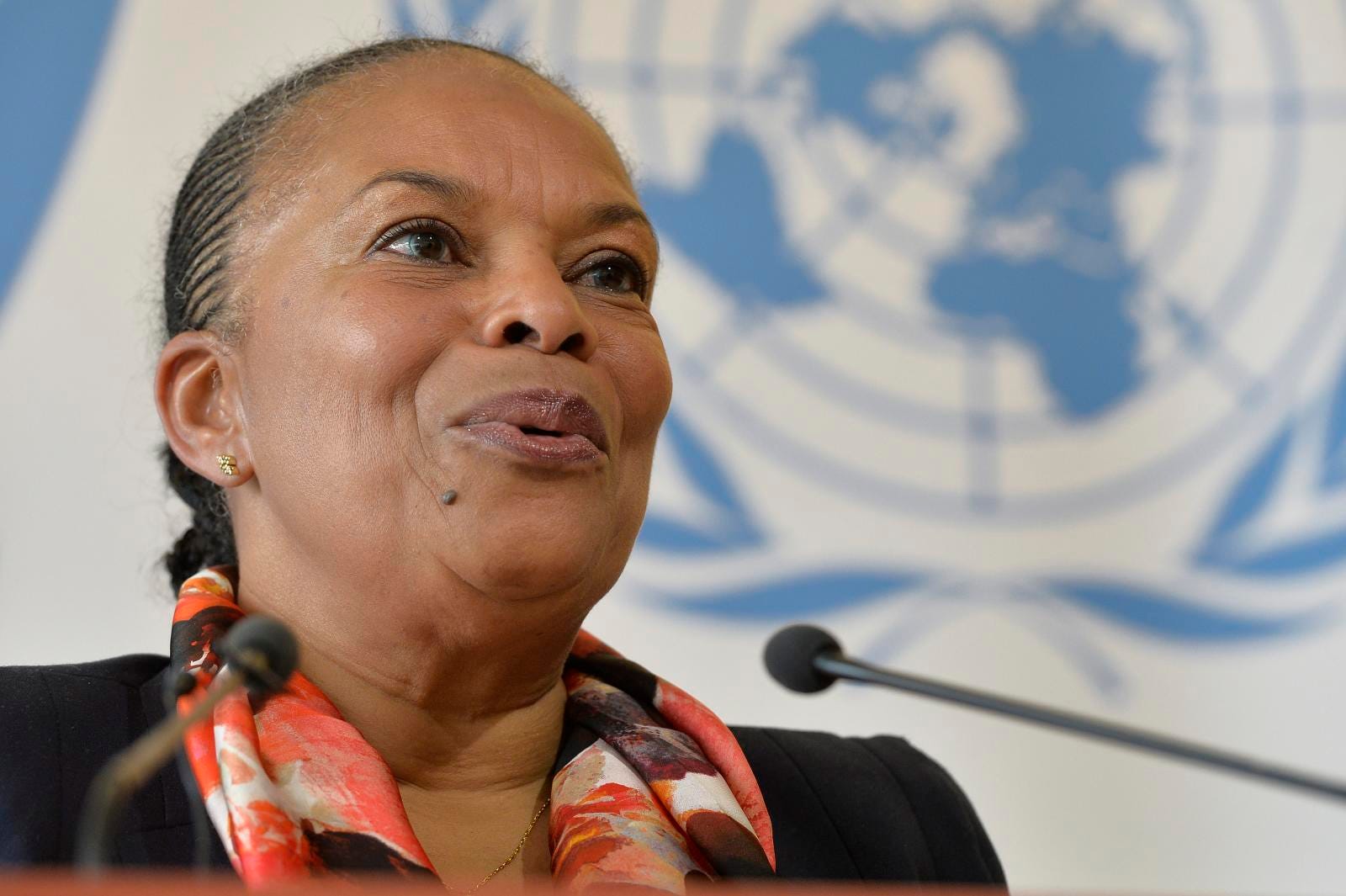
The context was a speech for the 25th anniversary of the loi Taubira, under which France officially recognised slavery and the slave trade as a crime against humanity.
Macron offered few specific details on the idea of reparations, and indeed was keen to stress that he would not offer “false promises”. He added that France would never be able to make full reparations for the crime of slavery, given its gravity – an expedient that also helpfully allows him to evade questions about money.
Little surprise there: the reparations bill for each individual country affected by European slavery is likely to be in the billions.
Nonetheless, even using the word “reparations” has already broken a longstanding presidential taboo, and Macron has offered one concrete step: a research project which will ultimately offer policy recommendations for addressing the legacies of slavery, to be run jointly with Ghana, a country that has long been at the forefront of African calls for reparations.
But why is a president who has spent the better part of the last two years wrestling with a budget crisis, and his entire presidency slashing state spending, now even entertaining the case for paying out reparations?
In some ways, the issue has been imposed on him. The anniversary of the loi Taubira, coinciding with the symbolic repeal of the Code noir, was always going to raise new questions about reparations.
If slavery is recognised as a historic crime against humanity, then it obviously demands redress.
Moreover, the clamour from states around the world that suffered from the slavery imposed by Europe has been growing for some time now, and will only continue to do so.
Although it excites little comment or debate in European newspapers, it has become an increasingly important sticking point for European powers in their negotiations with former colonies in both Africa and the Caribbean.
And for France, this is not simply a foreign policy issue. Many of the colonies to which enslaved people were trafficked and exploited are today formally (although not always in practice) integral parts of the Republic.
Deputies from these overseas departments have been leading the charge to repeal the Code noir, and they have been keen to link the issue of reparations to that symbolic action.
The areas they represent remain far poorer than metropolitan France, and there is broad sympathy on the left for the idea of offering them some kind of financial redress – although likely in the form of state investment rather than direct cash transfers
But it is still surprising that Macron seemed so willing to embrace the argument for reparations – as evidenced by the fact that it made headlines around the world.
So what is going on? As usual, Macron is playing a fairly blatant double game with what he thinks is subtlety.
In essence, he believes that he can curry favour with African leaders by accepting that historical redress is necessary, while shifting the focus of the reparations debate away from the financial and towards the symbolic: ceremonies and perhaps the return of some key artefacts, rather than euros.
He will be pleased that most of the global coverage has focused on his acceptance of the need for reparations, rather than his multiple caveats about actual financial commitments.
His hope is that he will be able to use this apparent concession to win back some goodwill in West Africa, from which the traditional French presence has been all but expelled in recent years.
He is also employing the issue to manipulate domestic politics, looking to establish a sensible centrist position that he can pose against the “anti-republican” extremes.
Here is how he would like his position to be understood: on the one side, there is the far right, which offers a triumphalist account of French history stripped of nuance that will prevent the country from moving on.
On the other, the far left, which wants to wallow in guilt and shame and hand over French taxpayer money to assuage their consciences.
And in the middle, his own nuanced position: France must recognise the crimes that it committed so that it can understand itself and its place in the world, but this must not tip over into self-recrimination or foolish excesses of financial largesse.
As usual, he is flattering himself. On the international stage, his hamfisted efforts to divert African leaders with the key-jangling of “symbolic reparations” is unlikely to win him any favour.
African governments are used to being fobbed off in exactly this way, and to put a stop to it they have now spent years methodically building the case for financial reparations on the international stage.
In 2023, the African Union established the Global Reparation Fund as a first step towards reparations claims, stating its intention to work through the UN, and via litigation if necessary, to ensure that they receive their dues.
And in March of this year, African and Caribbean nations brought the issue before the UN General Assembly, which voted overwhelmingly in favour of reparations. France was among the 52 nations that abstained from that vote.
Macron’s conviction that he can fool them into accepting symbolic gestures instead of hard cash will, rightly, be taken as an insult.
And on the domestic front, it is far from certain that Macron has the moral authority with which he clearly still credits himself. The majority of the country will feel he is in no position to be opining on what represents the correct ethical position on any matter, least of all this one.
At the same time, Macron does not himself need to worry too much about his gamble failing. By the time the various commissions that have been set up to examine the reparations question report, he will be in the final months of his presidency, with neither ability nor incentive to act on the matter.
It will be for his successor to come up with a more enduring answer to the demand for reparations.