
A social state without socialism
With the left marginalised, the debate over welfare is set to divide the right in unexpected ways

As in Britain, old-age pensions were introduced in France not by socialists, but by liberals. The first law creating mandatory contributions to pensions was passed in 1910 through the efforts of the left wing of the old Parti radicale, which straddled the centre of French politics for most of the beginning of the 20th century.
At the time, there were criticisms from both left and right: from the former, because the new pension age of 65 was higher than the life expectancy of the vast majority of workers, and from the latter on grounds that it would subsidise idleness and impinge upon the prerogatives of employers.
Welfare has never ceased to be a key defining line in French politics, any more than in the rest of the western world. But in 2026 the roles are reversed – while the left is consigned to the sidelines, the liberal centre has set itself firmly against welfare, or what it disparagingly calls the assistanat, and the far right is looking to establish itself as the champion of the social state.
Attacks on welfare have been the fil rouge of Emmanuel Macron’s two presidential terms. In 2018 he sparked outrage when he commented that the state was spending a pognon de dingue, which translates roughly as “a crazy amount of cash”, on welfare for the poor.
Not to be deterred, he went into his 2022 re-election campaign promising 25€ billion in budget cuts, 15€ billion of which were to come from the health budget.
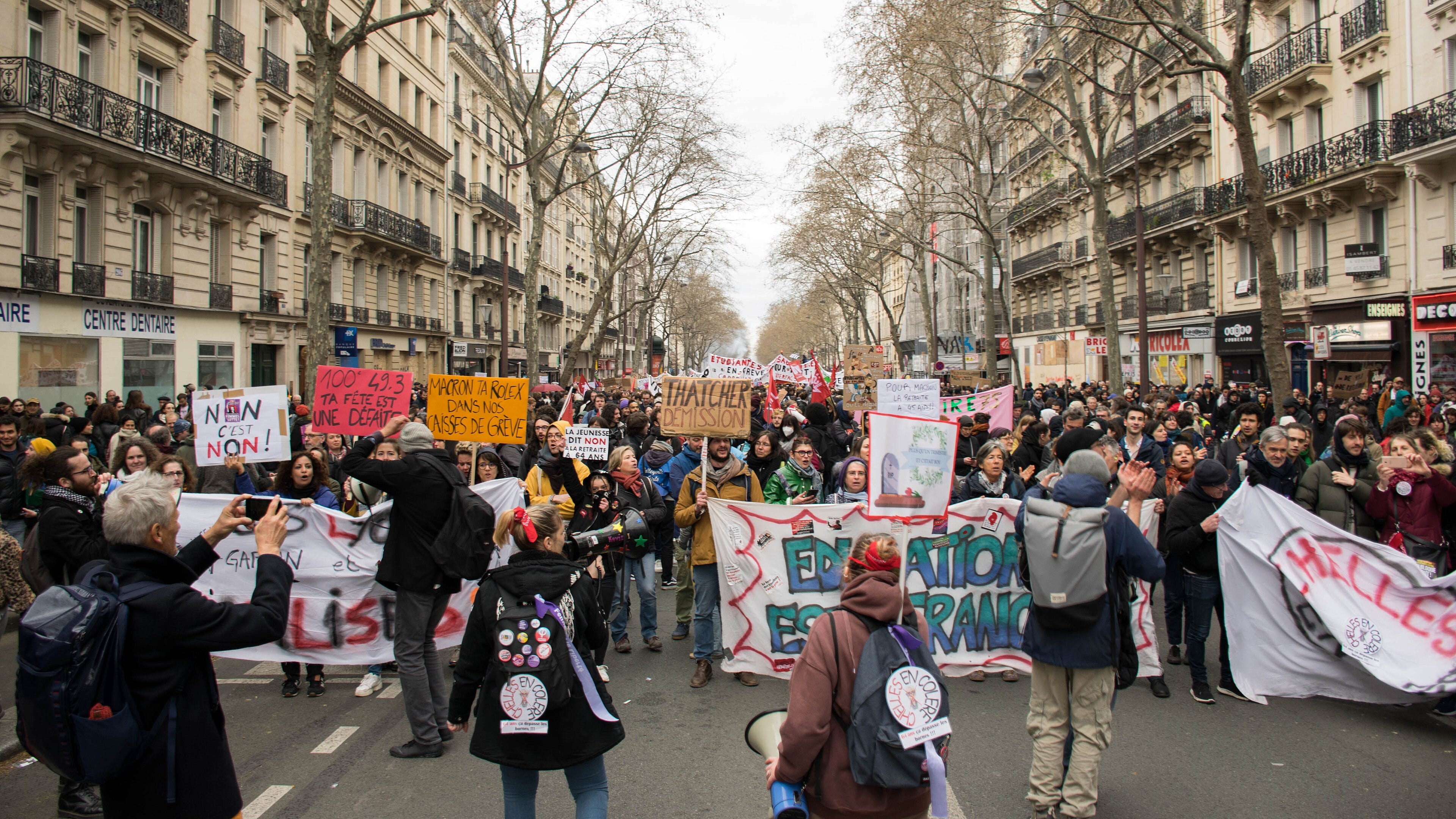
Then in 2023 came pension reform, still one of the most divisive episodes in recent French political history. The package in question, whose flagship policy was the raising of the legal retirement age from 62 to 64, was fiercely opposed by the unions, all of the left-wing parties – and also the far-right Rassemblement national (RN).
Why? Like most right-populist parties, the RN has built a base among older workers and retirees. These are the beneficiaries not only of pensions and health spending, but often of welfare programmes that support low-paid workers, disabled people, and indeed the unemployed.
Indeed, the party’s electoral appeal has hinged partly on its success in connecting the growing economic hardship among groups hit by Macron’s cuts to welfare with its central issue, immigration. It promises prospective voters that if migrants are deprived of state support, there will be more funds for “native” French people.
So the faultlines on welfare at the next election should be clear. Édouard Philippe, the most likely candidate of Macron’s centre-right Ensemble coalition, was, as prime minister from 2017-20, responsible for pushing through many of the president’s welfare-cutting measures.
He has already indicated that he would fight a potential campaign against the RN partly by associating them with the assistanat – a means of wooing right-wing voters who might be tempted by the RN offering on immigration but are worried about their fiscal rectitude.
Meanwhile, we would expect that the RN will present themselves as the new defenders of the proud French welfare state tradition, duly chauvinised through the exclusion of non-citizens.

But in reality, neither party can afford so simple a stance.
The RN is currently divided between two camps: that of Marine Le Pen and that of Jordan Bardella.
Both are waiting for a court decision due to be handed down on 7 July that will determine whether or not Le Pen is eligible to stand in the next election. If the verdict goes against her, Bardella is the candidate presumptive.
While Le Pen’s instinct is to stick to the party’s current pro-welfare strategy, Bardella has been forging closer ties with the infamous patronat, the business owners, who have been slow to warm to the RN largely due to concerns about the economic competence of the so far untested far-right party.
The price of their support would likely be a more hostile stance to state spending. Which is why figures close to Bardella have been suggesting that the party might drop its current policy of restoring the retirement age to 62 – meeting fierce pushback from Le Pen loyalists, who feel this would be a betrayal of their base.
And they might be right. The RN cannot afford to take its older and poorer supporters for granted, especially since Jean-Luc Mélenchon of La France insoumise (LFI) is likely to make an aggressive pitch for them.
The great strength of the RN has been its capacity to appeal to traditional left-wing voters while hoovering up rightward-drifting conservatives.
Now they reckon the next lot of gains to be made are to be found among the old right, the economic conservatives; but if they advance too enthusiastically into this territory, they risk losing the more economically interventionist part of their base.
Earlier this month, Le Pen seemed to make some concessions to Bardella’s position in the hope of keeping the peace, but that does not mean the movement as a whole is convinced. The party could end up tearing itself to pieces over its pensions policy, especially if she is barred from standing and Bardella takes the helm of the RN’s presidential campaign.
But Philippe will not have an easy ride either. He cannot count on beating the RN in the second round of the election with right-wing votes alone – he will have to persuade at least part of the left to swallow the toad for the third election running and vote for another centre-right presidential term.
It will be tempting to fall back on the old assumption that the left will rally round the centre right each time the far-right threat looms, but the truth is that the “barrage républicain” has never looked flimsier.

The last two presidential elections, which both pitted Macron against Le Pen, each successively saw the highest rates of voter abstention in the second round since 1969. Turnout was lowest among left-wing voters.
All signs are that the left has come to resent the constant demand that they rescue France from the far right without receiving anything in return. It would be a risky strategy to force them into this position once again.
Moreover, before that, Philippe has to get through the first round. While he is currently the favourite to come second to the RN – this phrasing is a sign of how far the French political landscape has been corrupted in the last ten years – and make it to the run-off, he cannot necessarily afford to antagonise the centre left too much.
Running a welfare-bashing campaign would risk driving them towards Mélenchon, the only candidate of the left who could pip Philippe to the post.
And if Raphaël Glucksmann stands as the candidate of the only-slightly-left-of-centre, as he has indicated he might, that could make things more complicated for Philippe.
Glucksmann has little support in the traditional bastions of the left – he has even been advised by his own team to avoid trying to campaign in the banlieues and among the young – so he will be competing for Philippe’s more well-heeled centrist voters, potentially leaving an avenue for Mélenchon to come through the middle (an unusual position in which to find himself).
If, on the other hand, Philippe plays his cards right, he could breeze through to the second round with the backing of a portion of the centre-left. Some members of the Parti socialiste (PS) have indicated that they would be open to supporting Philippe from the get-go.
Their calculation is that it is too late for a non-Mélenchon candidate to get any traction on the left, and so they are willing to throw their in lot with the centre right instead, hoping thereby to stop Mélenchon in his tracks and deal a serious blow to LFI, their rivals on the left.
That would be an ideal situation for Philippe: winning the first round with a “barrage républicain” against both the RN and Mélenchon’s LFI would grant him significant momentum, establish him early as the republican candidate, and perhaps help induce the wider left to back him in the second round.
But for his centre-left support to go beyond a handful of UMPS apparatchiks with a vendetta against LFI, he would need to make some concessions. However abject the old guard of the PS might have become, even they will baulk at wholeheartedly endorsing a candidate who is too enthusiastic about making yet more cuts to welfare.
So both the favourites for 2027 may find they have to be less than forthcoming on the issue of the social state, as French politics continues to realign itself in strange new directions.
And if either one fails to maintain this delicate balance – for the RN, winning over the patronat while keeping older and poorer supporters on board, and for Philippe, holding on to fiscal conservatives while avoiding demoralising the centre left entirely – then it could be fatal for their chances of winning the Élysée.